
Before this unit: Image formation
What Is Camera Calibration? Finding K from Photos of a Chessboard
Lesson 3 of Camera Geometry. Calibration measures a camera's focal length, image centre and lens bend by fitting the camera model to photos of a flat board whose corners are known. On OpenCV's thirteen chessboard photos: 0.41 px of reprojection error, a held-out photo that scores like the fitted ones, and a focal length anywhere from 520 to 568 px if only three photos are used.
Camera calibration measures the numbers that describe a camera, its focal length, its image centre and how its lens bends straight lines, from photographs of an object whose shape is known. Below, a photograph straightened with those numbers once they are known.

You have met it wherever a camera is trusted to measure:
- Phone makers calibrate every camera module on the production line, and the phone’s AR and portrait features read those numbers.
- Robots, cars and drones calibrate their cameras before any distance they report means anything.
- Photogrammetry and 3-D scanning calibrate first or estimate the same numbers along the way.
cv2.calibrateCamera, the OpenCV call this lesson runs on the page.
Calibration finds a camera’s own numbers by fitting the camera model to many photos of a flat board whose corners are known, and the fit is only as good as the photos it is given. Thirteen photos fit OpenCV’s sample camera to 0.41 px; any three of them leave the focal length anywhere from 520 to 568 px.
Where we are
Lesson 3 of camera geometry, and step 6 of its pipeline with many photos: compare the corners the model predicts with the ones the detector found, and adjust the camera until they agree. Lesson 2 used a and a lens that were given. This lesson is where they come from [1] [2].
Why one photo is not enough
A flat board in one photo gives a homography between the board and the image: eight numbers.
The camera needs eleven, five in and six for where it stood, so one photo leaves three
unknown. Zhang’s method, the one behind cv2.calibrateCamera, shows that every photo of the
board adds two equations about alone, because the board’s two axes are at right angles
in the world. Three photos at different angles fix ; more of them average out the noise
of corner detection, and the lens coefficients come from the corners near the edges
[1].
What calibration minimises
The fit has one score, the reprojection error: push every known board corner through the camera model, measure how far each lands from where the detector found it, and take the root mean square over every corner of every photo. Calibration adjusts , the five lens coefficients and one per photo until that number is as small as it gets [2].
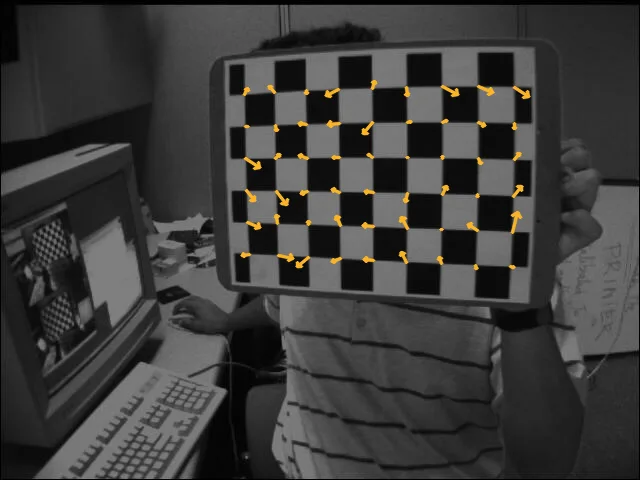
How close is this to OpenCV?
The page calibrates for real with cv2.calibrateCamera [3], from the corners the detector found in each of the thirteen
photos (served as a 12 KB file, because detecting them takes the full images). Then it asks
the question the reprojection error cannot answer on its own: how does the calibration do on
a photo it never saw?
import json
import numpy as np
import cv2

d = json.load(open("corners.json"))
# the board's own coordinates, one unit per square
obj = np.zeros((54, 3), np.float32)
obj[:, :2] = np.mgrid[0:9, 0:6].T.reshape(-1, 2)
img = [np.float32(c).reshape(-1, 1, 2)
       for c in d["corners"]]
size = tuple(d["image_size"])

rms, K, dist, rvecs, tvecs = cv2.calibrateCamera(
    [obj] * len(img), img, size, None, None)
print(len(img), "views, RMS", round(rms, 4), "px")
print("fx, fy:", K[0, 0].round(2), K[1, 1].round(2))
print("cx, cy:", K[0, 2].round(2), K[1, 2].round(2))
print("k1, k2, p1, p2, k3:", dist.ravel().round(4))13 views, RMS 0.4087 px fx, fy: 536.07 536.02 cx, cy: 342.37 235.54 k1, k2, p1, p2, k3: [-0.2651 -0.0466 0.0018 -0.0003 0.252 ]
# a view the fit never saw: calibrate on the other 12,
# then place the first board with that camera
K12, d12 = cv2.calibrateCamera(
    [obj] * 12, img[1:], size, None, None)[1:3]
ok, rv, tv = cv2.solvePnP(obj, img[0], K12, d12)
p, _ = cv2.projectPoints(obj, rv, tv, K12, d12)
e = np.sqrt(np.mean(np.sum(
    (p - img[0]).reshape(-1, 2) ** 2, axis=1)))
print("first view, held out:", round(float(e), 3), "px")

# the same 13 views with no lens model at all
flags = (cv2.CALIB_FIX_K1 | cv2.CALIB_FIX_K2
         | cv2.CALIB_FIX_K3 | cv2.CALIB_ZERO_TANGENT_DIST)
rms0, K0 = cv2.calibrateCamera(
    [obj] * 13, img, size, None, np.zeros(5),
    flags=flags)[:2]
print("pinhole only: RMS", round(rms0, 3),
"px, fx", K0[0, 0].round(2))first view, held out: 0.2 px pinhole only: RMS 1.555 px, fx 557.45
The page’s OpenCV 4.11 returns the same 0.4087 px and as the repository’s 5.0. Held out, the first photo scores 0.20 px, about what it scored when it was part of the fit: over all thirteen, leaving each out in turn gives a median of 0.204 px against 0.194 in-sample. Dropping the lens model costs a factor of almost four, 1.555 px, and pushes the focal length 21 px off to absorb the bend.
In the wild
The same fit on a different lens shows what a wrong model looks like. Unit 1.1’s fisheye,
fifteen photos of a board, calibrated with the model above, fits to 7.326 px; with a fisheye
model, cv2.fisheye.calibrate, the same corners fit to 0.644 px
(lesson 4 of unit 1.1). A reprojection error several
times larger than the corner detector’s own accuracy is a model that does not describe the
lens, whatever the number of photos.
Where this breaks
Too few photos. Every one of the 286 ways to choose three of the thirteen photos gives a calibration, and their focal lengths run from 519.6 to 567.9 px; the middle 90% from 530.2 to 544.3. Each of those fits has a small reprojection error on its own photos. The error says how well the model fits what it was shown, not whether what it was shown was enough.
Photos that all look alike. The equations about come from the board being seen at different angles. A set of photos taken straight on, or all tilted the same way, leaves the focal length and the board’s distance trading off against each other.
Board squares, not metres. The square size of OpenCV’s board is not published, so and the lens are right and every distance is in squares. A real calibration measures the square.
Exercises
- The board’s coordinates. Write
board(cols, rows), the 3-D positions of a board’s inner corners in squares, in the order the detector returns them.
def board(cols, rows):
    return np.zeros((cols * rows, 3), np.float32)

print(board(9, 6)[:3])- Predict, then run. Calibrate on three photos at a time: views (0, 1, 2), (0, 5, 10) and (3, 7, 11). How close do they come to the thirteen-photo ?
- Read the table above. Which is the larger risk on this set: too few photos, or no lens model?
What you should see
These come from the “Lesson 3” cells of the unit notebook, camera_geometry.ipynb, and are
the same on OpenCV 4.11 (this page) and 5.0.
[[0, 0, 0], [1, 0, 0], [2, 0, 0]]for the first three rows.- 538.2, 537.8 and 534.6, against 536.1: these three subsets are among the good ones. Over all 286, the focal length runs from 519.6 to 567.9.
- Both move by tens of pixels: three photos by up to 32 px, no lens model by 21. Only the missing lens model also shows in the reprojection error, four times larger; three photos fit their own corners well and hide the problem.
Check yourself
Four questions on this lesson. Pick an answer to see why it is right or wrong.
Why can one photo of a flat board not calibrate a camera?
Each further photo adds two equations about K, which is why Zhang’s method uses several views at different angles.
What does calibration minimise?
It adjusts K, the lens coefficients and one pose per photo until that RMS is as small as it gets: 0.4087 px on the 13 photos.
Calibrated on any three of the 13 photos, how far can the focal length land from the 13-photo 536 px?
Each three-photo fit still has a small error on its own photos. The reprojection error says how well the model fits what it was shown, not whether that was enough.
With no lens model, the same 13 photos fit to 1.555 px. What does that say?
The focal length also moves 21 px to absorb the bend, which is why the lens coefficients are part of calibration.
Next
With and the lens known, one photo of the board is enough to find where the camera stood: lesson 4, PnP.
References
[1] Zhang, Z. (2000). A flexible new technique for camera calibration. IEEE Transactions on Pattern Analysis and Machine Intelligence, 22(11), 1330–1334. doi:10.1109/34.888718
[2] Szeliski, R. (2022). Computer Vision: Algorithms and Applications (2nd ed.), §11.1 “Geometric intrinsic calibration” (p. 685). Springer. Free PDF
[3] OpenCV Documentation (5.0). Camera Calibration and 3D Reconstruction (calib3d): calibrateCamera, findChessboardCorners, cornerSubPix. docs.opencv.org/5.0