
Blog
Page 4 of 5
 Fundamentals
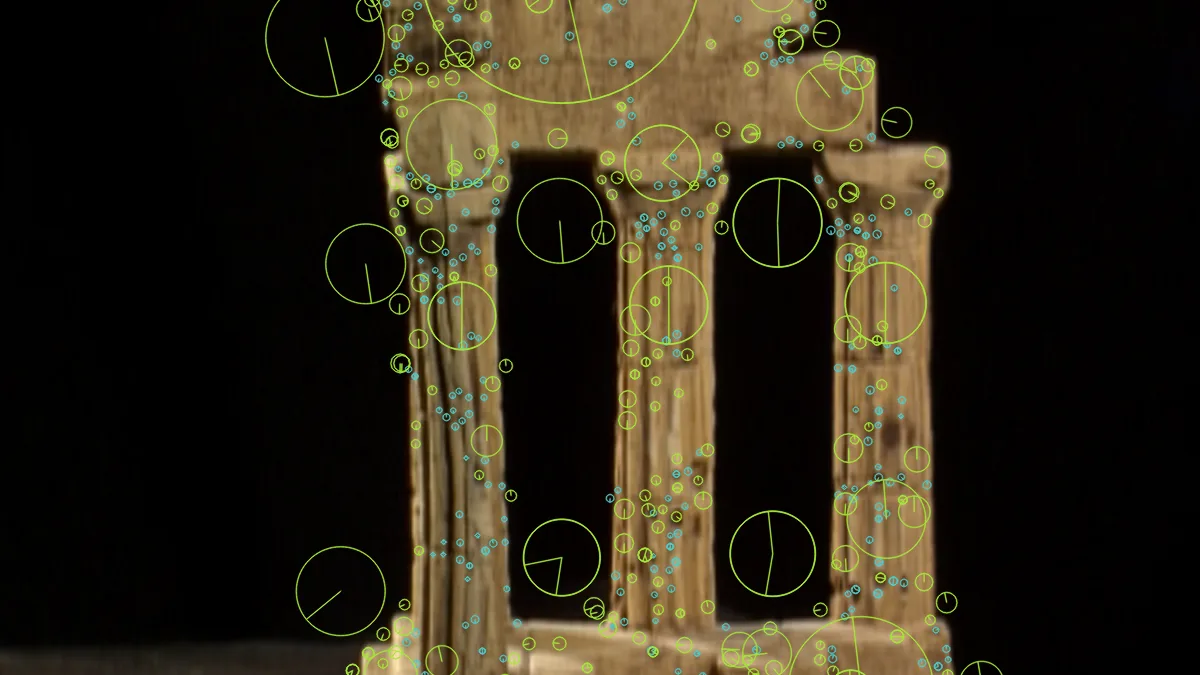
 What Makes a Point Matchable? SIFT, From Pixels to 128 Numbers
How SIFT turns a patch of pixels into 128 numbers that survive a moving camera. Measured on a real photo: a 45-level difference-of-Gaussians pyramid finds 791 keypoints spanning 1.8 to 112 px, each becomes a 128-dimensional descriptor, and Lowe's ratio test turns 791 candidates into 237 trustworthy matches. The invariances are real but bounded: 98.8% precision through a 45° rotation, and the scene is lost by 38° of viewpoint change. Every number has an artifact.
 Fundamentals
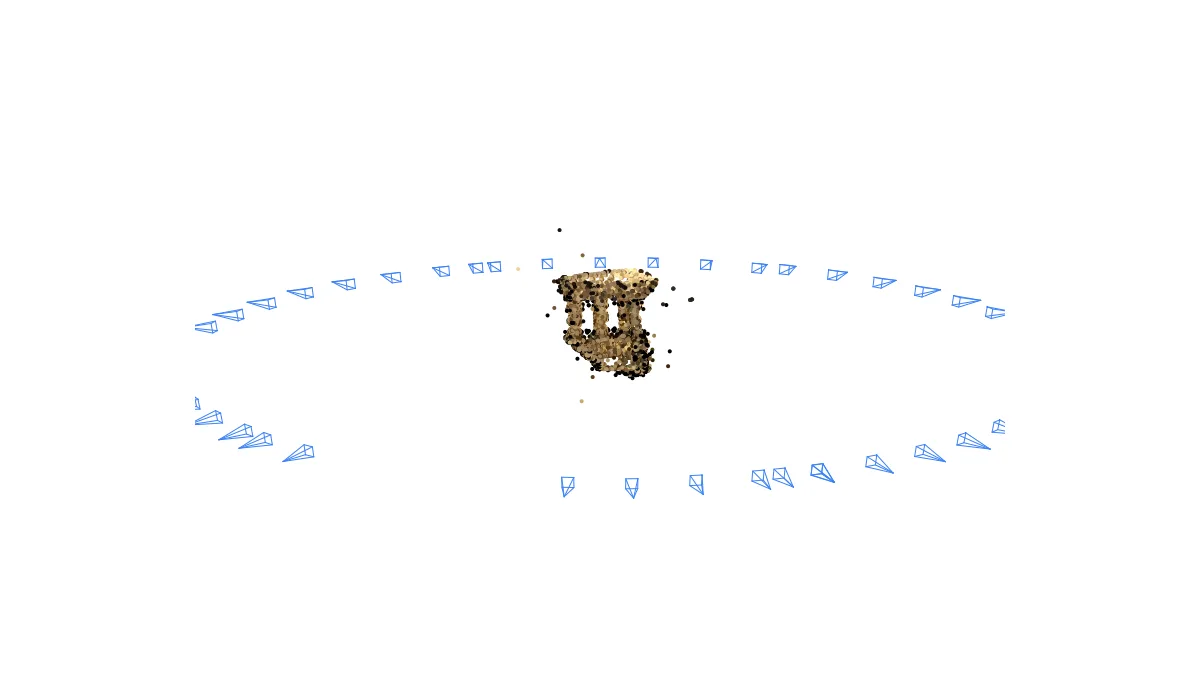
 Structure from Motion, from Scratch: 47 Photos to a 3-D Temple in ~800 Lines of Python
How overlapping 2-D photos become 3-D points and camera poses: SIFT matching, the essential matrix, triangulation, PnP growth, and sparse bundle adjustment, built from scratch with OpenCV + SciPy. The pipeline registers all 47 Middlebury temple views at 0.25 px mean reprojection error, next to COLMAP's 0.30 px on the same images. Worked examples, three interactive labs, and the reconstruction growing image by image.
 Models & Detection
 YOLO-NAS Strikes Back: Still the Fastest Detector on Hardware You Already Own
Quantized to INT8, YOLO-NAS-S runs at 270 FPS on a laptop CPU and 1146 FPS on a mid-range laptop GPU, and it drops straight into Frigate. The model aged well; its tooling did not. Here is a clean reimplementation, measured across CPU, Intel iGPU and NVIDIA dGPU, and checked bit-for-bit against the original.
 Fundamentals
 Camera Models, End to End: K, the Extrinsics, Calibration & PnP, with OpenCV
How a 3-D point becomes a pixel and back again: the intrinsic matrix K, the extrinsics R|t that place the camera in the world, Zhang calibration to 0.35 px reprojection error, and solvePnP recovering a 68-px-off pose to ~0. The math, two interactive labs, and runnable OpenCV in Python and C++.
 Fundamentals
 Image processing, computer vision, and computer graphics: one picture, three directions of the arrow
Three fields, one shared object: the digital image. Graphics turns a model into an image (forward), vision turns an image into a model (inverse), and image processing turns an image into a better image. Worked on a single red-ball scene, with a 1957→2026 timeline of how they split apart and re-merged.
 Fundamentals
 How 2D Convolution Works on Images: Kernels, Filters, and the Math, Interactively
2D convolution is the operation behind blur, sharpening, edge detection, and every CNN. Slide a kernel, multiply, sum: see it happen step by step in an interactive demo, apply real kernels to a live image, and get the math plus runnable OpenCV in Python and C++.
 Evaluation
 Classification Metrics, From the Ground Up: Precision, Recall, F1, ROC and AUC
The confusion matrix and everything that falls out of it: precision, recall, F1, specificity, the precision/recall trade-off, PR and ROC curves, and AUC, all built on one running toy example (a backyard cat-cam), with the equations, the intuition, and scikit-learn.
 Fundamentals
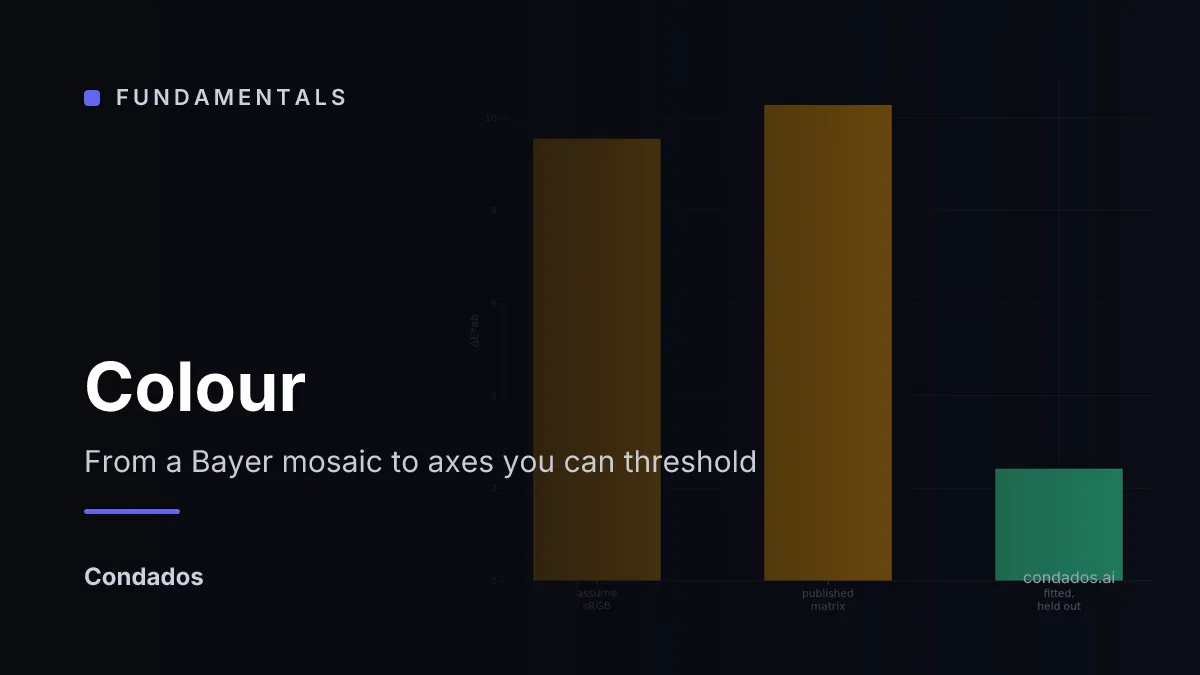
 Colour Spaces: Choosing Axes You Can Threshold
Lesson 4 of The Image as Data. A colour space is a choice of axes for the same three numbers, and the choice is what makes a question easy or impossible. Worked on one measured chart patch: RGB (149.8, 58.3, 34.0) becomes luma 82.8, hue 12 degrees stored as 6, and a Lab triple — plus the five-line red detector that is brittle in RGB and robust in HSV.
 Evaluation
 Image Generation Metrics: FID, IS, KID, LPIPS, and CLIPScore
How do you score images with no ground truth? You compare distributions and use learned perceptual models: Inception Score, Fréchet Inception Distance, KID, LPIPS, and CLIPScore for prompt fidelity, on one running cat-generator example, with the equations, the catches, and torchmetrics.