
Blog
Page 2 of 5
 Fundamentals
 Image Sensing: What the Number in a Pixel Actually Counts
The unit overview: how a photon becomes an integer, why that integer is a random variable, what the tone curve did to it before you saw it, and how eighteen exposures merge back into light you can put a unit on. Measured on one scene: gain 0.294 DN per electron, a full well near 13,200 e⁻, and a merged bracket that lands 0.109 stops from a colorimeter across the neutral patches.
 Fundamentals
 Lens Distortion: Where the Straight-Line Model Actually Fails
Lesson 3 of the Image Formation unit. Real glass bends rays more at the edges, and the error grows with the sixth power of radius. Measured on OpenCV's calibration set: the top-left pixel of a 640x480 frame belongs 51.22 px from where the pinhole model puts it, and adding the Brown-Conrady terms drops the mean reprojection error of one view from 2.55 px to 0.170 px. Straightening it back costs field of view rather than pixels: 61.67 degrees becomes 67.32.
 Fundamentals
 Lenses and Depth of Field: What You Buy With Light, and What It Costs
Lesson 2 of the Image Formation unit. A lens buys the brightness a pinhole cannot have and charges a plane of focus for it. Worked on a published scene: 93 mm at f/4 focused at 1.52 m is sharp from 1.500 m to 1.550 m, a band 5 cm deep. Stopping down to f/22 widens it to 0.277 m, a factor of 5.54 against an aperture ratio of 5.50, and the circle of confusion behind those numbers comes out at 0.0248 mm.
 Fundamentals
 The Pinhole Model: Why a Hole Makes a Picture, and Where the Prediction Fails
Lesson 1 of the Image Formation unit. A pinhole projects a scene point to a pixel by similar triangles, and that is a prediction you can check. Worked on one board corner from OpenCV's calibration set: the model puts it at (523.98, 77.94) and the detector found it at (513.77, 86.53), 13.34 px apart. Across the view the error is 0.29 px in the middle third of the frame and 5.75 px in the outer third, which is the shape of the problem the rest of the unit solves.
 Fundamentals
 Quantization: How Many Bits a Pixel Deserves
Lesson 3 of The Image as Data. Rounding to fewer levels costs Δ/√12 of error, and on this camera's mid-tones the formula predicts the measurement to within 2%. Set that error equal to the read noise unit 1.2 measured and the crossing lands at 9.3 to 9.5 bits — so a 12-bit file on this sensor carries about two and a half bits of nothing.
 Fundamentals
 Sampling: What One Pixel Covers, and What Falls Between
Lesson 2 of The Image as Data. One photosite on this camera is 5.527 µm and covers 1.056 arcminutes of the room. The table in the frame is ribbed at 7.4 pixels per cycle; keep every 8th pixel and it comes back at 96 pixels per cycle — thirteen times too coarse, and predicted exactly by folding the frequency.
 Fundamentals
 Sensing Colour: The Bayer Mosaic, and What Interpolation Costs
Lesson 5 of Image Sensing. A silicon photosite is colourblind, so a mosaic of filters gives each one a single colour — a quarter red, a quarter blue, half green. Two thirds of every colour image is therefore interpolated, and measured against photosites that actually exist, that guess costs 4.7 DN on a flat patch and 129.9 DN at an edge: twenty-eight times worse where it shows.
 Fundamentals
 Sensor Noise and Dynamic Range: Measuring the Gain You Were Never Told
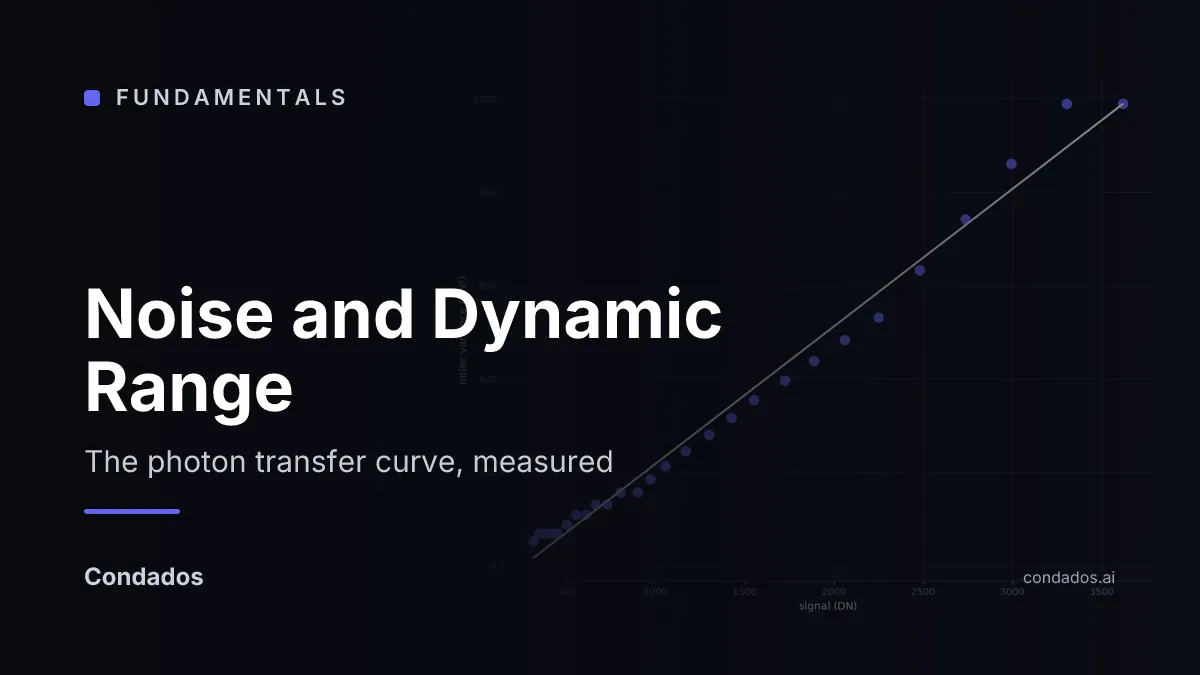
Read the same photosite three times and you get three numbers. Plotting the variance of a count against its mean gives a straight line whose slope is the sensor's gain: 0.294 DN per electron on this camera, R² = 0.986, a full well of 13,199 electrons and at least 11.21 stops of dynamic range — none of which appears anywhere in the file.
 Fundamentals
 The Camera Response Curve: Why Your JPEG Is Not Proportional to Light
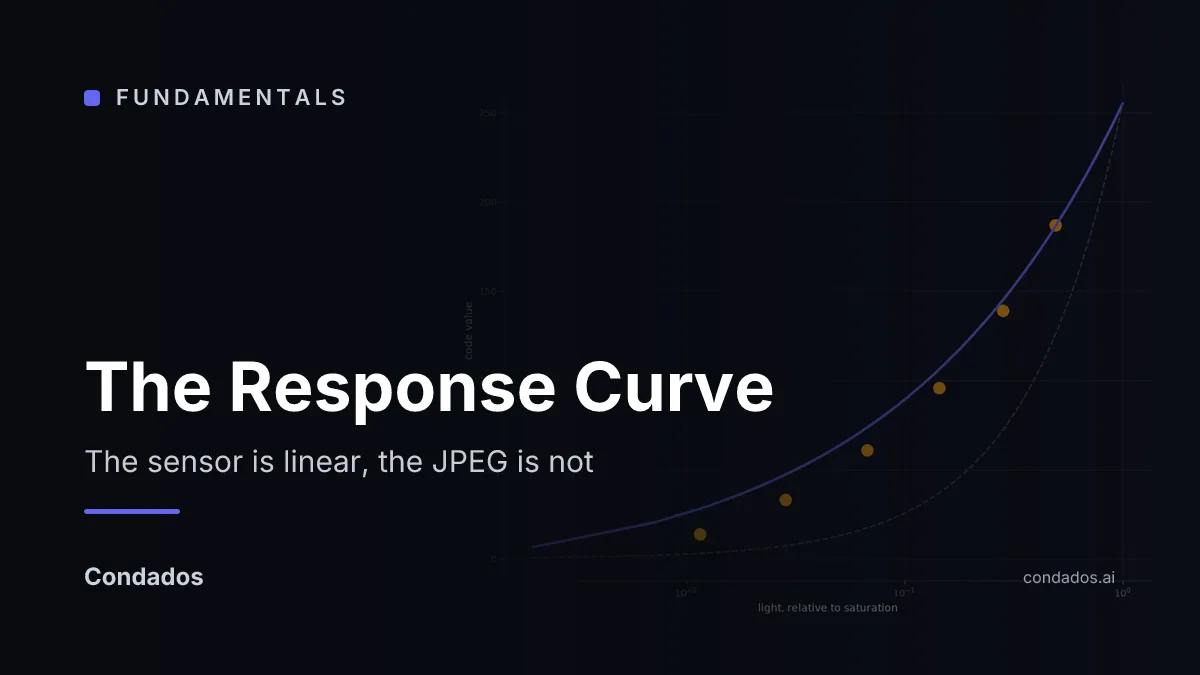
Raw counts are proportional to the light that arrived. The developed file is not: on the same six neutral patches, a linear ratio of 42 to 1 comes out as 187 against 14 code values. Measured here — a single exponent misses by 9.6 code values, because the curve is a gamma with a contrast S stacked on it.