
Blog
Page 7 of 9
 Fundamentals
The Camera Response Curve: Why Your JPEG Is Not Proportional to Light
Raw counts are proportional to the light that arrived. The developed file is not: on six neutral patches, a 42:1 ratio of light comes out as 187 against 14 code values. Measured here, the file sits a mean 9.6 code values off the sRGB curve, and the BT.709 curve the developer applied by default accounts for most of that.
 Fundamentals
The Image as Data: The Grid, the Integers, the Axes, and the File
The unit overview: what an array actually holds, where its samples sit, how finely each one is written down, what its three numbers mean, and what the encoder did before you read any of it. Measured on one photograph: two thirds of a colour image is interpolated, a 7.4-pixel ribbing returns as 96-pixel banding when you decimate by eight, bit depth stops buying anything at 9.4 bits, and the naive route from file to colour lands 9.54 ΔE from the light in the room.
 Fundamentals
Fisheye Models: When Correcting the Lens Stops Working
Lesson 4 of the Image Formation unit. The pinhole model puts a ray at f·tan θ, which runs to infinity at 90 degrees, and past about 120 degrees of field the stretch toward the edges makes it impractical. Fitted to the same 15 photographs of one fisheye lens, pinhole plus Brown-Conrady reaches 7.326 px RMS and Kannala-Brandt reaches 0.644 px. At 80 degrees the first model predicts a radius of -35,572 px, a sign flip; the second predicts 458.8 px, which is on the sensor.
 Fundamentals
Canny: Non-Maximum Suppression and Hysteresis, Taken Apart
Canny is two independent mechanisms. NMS collapses a five-pixel ridge to one pixel by comparing along the gradient; hysteresis keeps a weak chain because it touches a strong seed. Worked on nine numbers: a single threshold gives either 1 pixel or 9, and hysteresis gives the 6 that belong to a real contour. Measured on a photo, that is 204 contours averaging 18.68 px against 393 averaging 9.69 px at the same pixel budget.
 Fundamentals
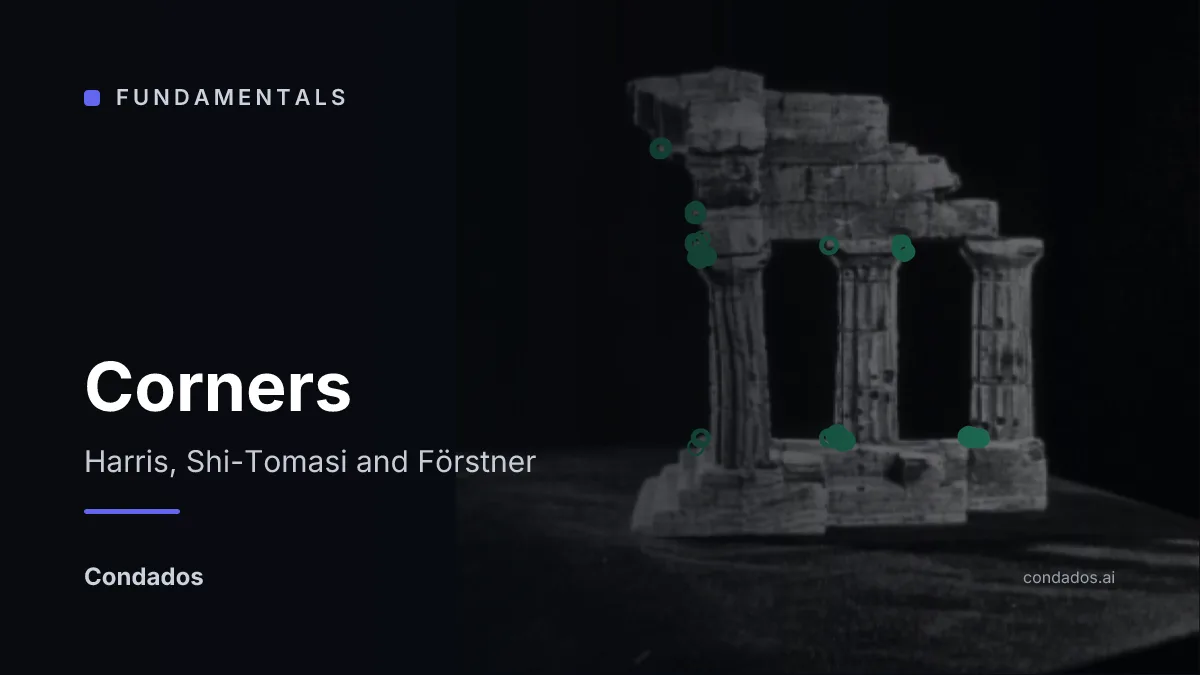
Corners: The Structure Tensor, Harris, Shi-Tomasi and Förstner
A contour says where a boundary runs but not where you are along it. Two eigenvalues of a 2x2 matrix fix that: measured on a real photo, flat background scores 0.001/0.000, an edge 0.411/0.019 and a corner 0.442/0.318. Harris, Shi-Tomasi and Förstner all read that same matrix, and on the edge patch Harris comes out positive at k = 0.04 and negative at k = 0.06, so k decides the answer rather than the data.
 Fundamentals
Edge Detection: Finding Where One Thing Stops and Another Begins
How to find, in any photo, the places where one thing stops and another begins, and turn them into a clean black-and-white edge map. One pipeline, from grey to smoothed to the change at every pixel to thin linked edges, with corners as a branch, measured on one photo and shown step by step on another.
 Fundamentals
Image Gradients: Central Differences, Prewitt and Sobel
Three operators compute the same derivative and behave differently on a noisy photo. Worked by hand on a 3x3 patch: Sobel gives Gx = Gy = 1.80, a magnitude of 2.55 and an orientation of 45 degrees, while Prewitt gives 1.20 and 1.70 on identical pixels. Measured across a noise sweep, Prewitt beats Sobel at every level, and the reason is that its normalised weights have a smaller sum of squares.
 Fundamentals
The Laplacian, LoG and Zero-Crossings
The second derivative crosses zero at an edge instead of peaking, and interpolating between two samples places a step edge at x = 3.5. The naive Laplacian has no smoothing in it: nine pixels disturbed by 0.03 produce four sign changes where there should be one. Measured on a photo, noise multiplies the zero-crossing pixels by 2.76x at sigma = 1.0 and 1.02x at sigma = 3.0, and only 33% of the clean-image contours are closed.
 Fundamentals
What Is an Edge? Step, Ramp and Roof, and the Two Derivatives That Find Them
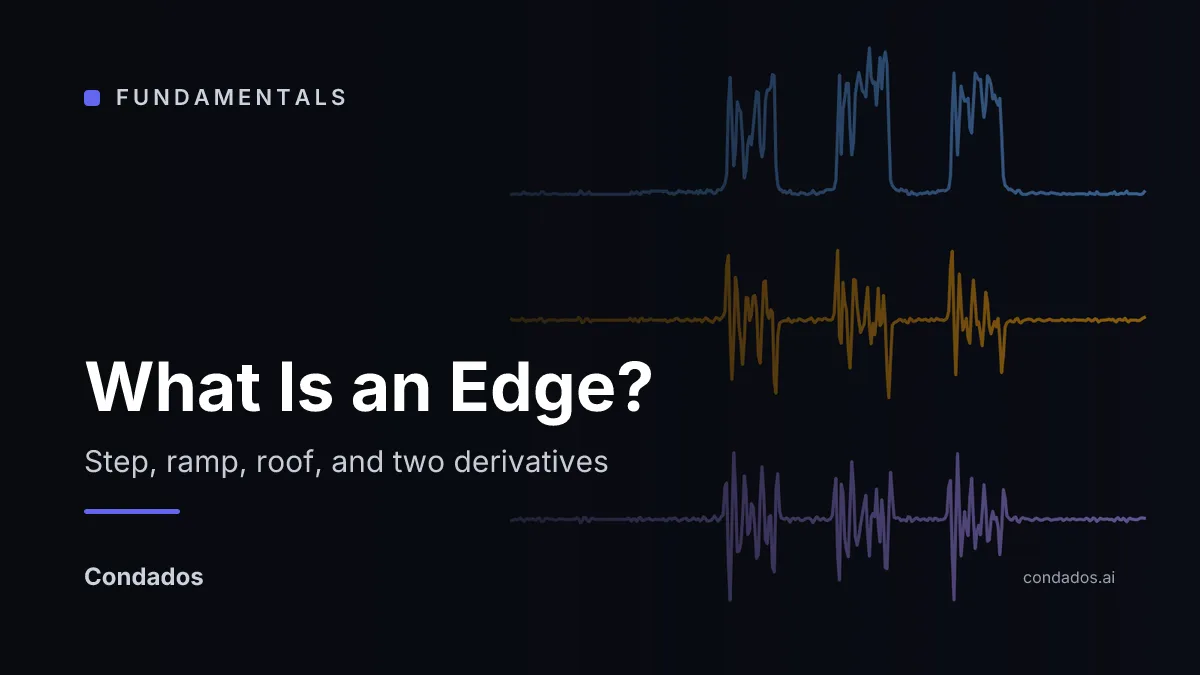
An edge is a peak in the first derivative and a sign change in the second. Worked by hand on nine pixels: the peak lands on column 4 and the second difference is exactly zero there. Add noise of at most 0.03 and the zero-crossing moves by 0.05 px, which is small; the real cost of the second derivative is the sign changes noise makes on its own, with no size attached to threshold, which is why Canny is built on the first derivative.