
sensors
7 posts · browse all tags
 Fundamentals
 From Photons to Counts: What a Raw Number Means
A photosite collects electrons, a converter turns them into an integer, and that integer is all any algorithm ever sees. Measured on eighteen exposures of one scene: the count doubles with the shutter to within a few percent, then sticks near 3875 DN — and the ceiling the file declares is not the ceiling the sensor has.
 Fundamentals
 High Dynamic Range: Merging a Bracket, Then Checking It Against a Meter
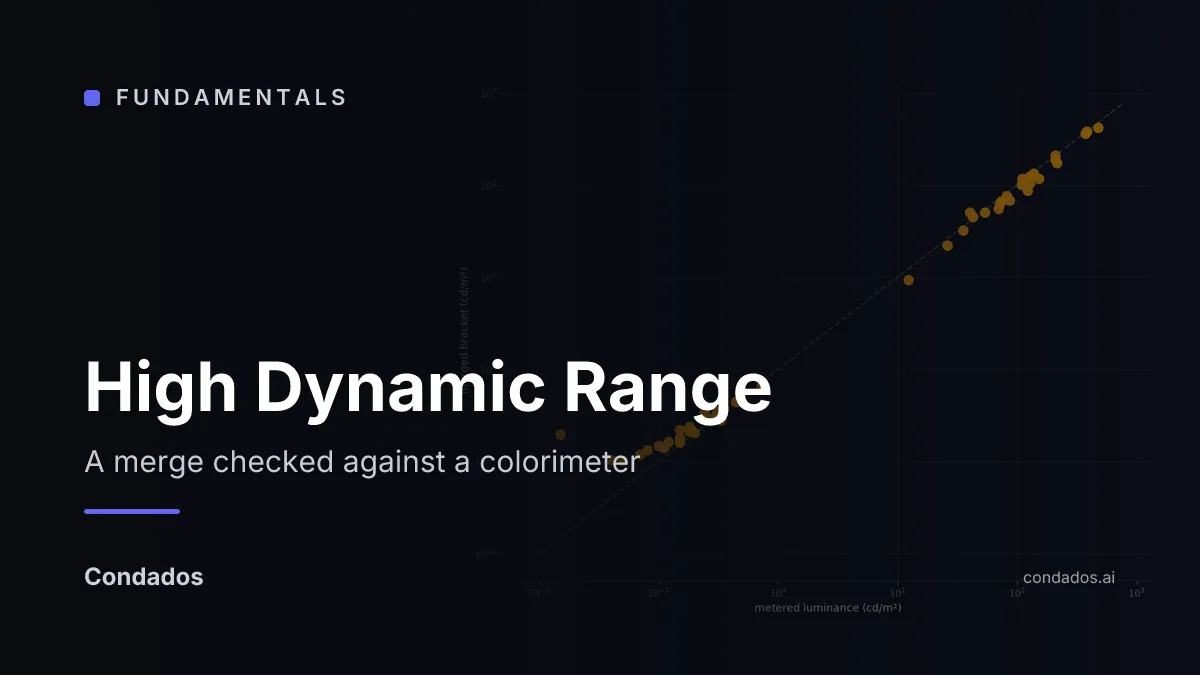
Eighteen exposures of a 17-stop scene, merged into one radiance map, calibrated with a single scale factor fitted on one patch — and then compared with the colorimeter readings taken in the room. The other 47 points land a median of 0.198 stops away, 0.109 stops across the neutral patches, and every large error is at the dark end.
 Fundamentals
 Image Sensing: What the Number in a Pixel Actually Counts
The unit overview: how a photon becomes an integer, why that integer is a random variable, what the tone curve did to it before you saw it, and how eighteen exposures merge back into light you can put a unit on. Measured on one scene: gain 0.294 DN per electron, a full well near 13,200 e⁻, and a merged bracket that lands 0.109 stops from a colorimeter across the neutral patches.
 Fundamentals
 Quantization: How Many Bits a Pixel Deserves
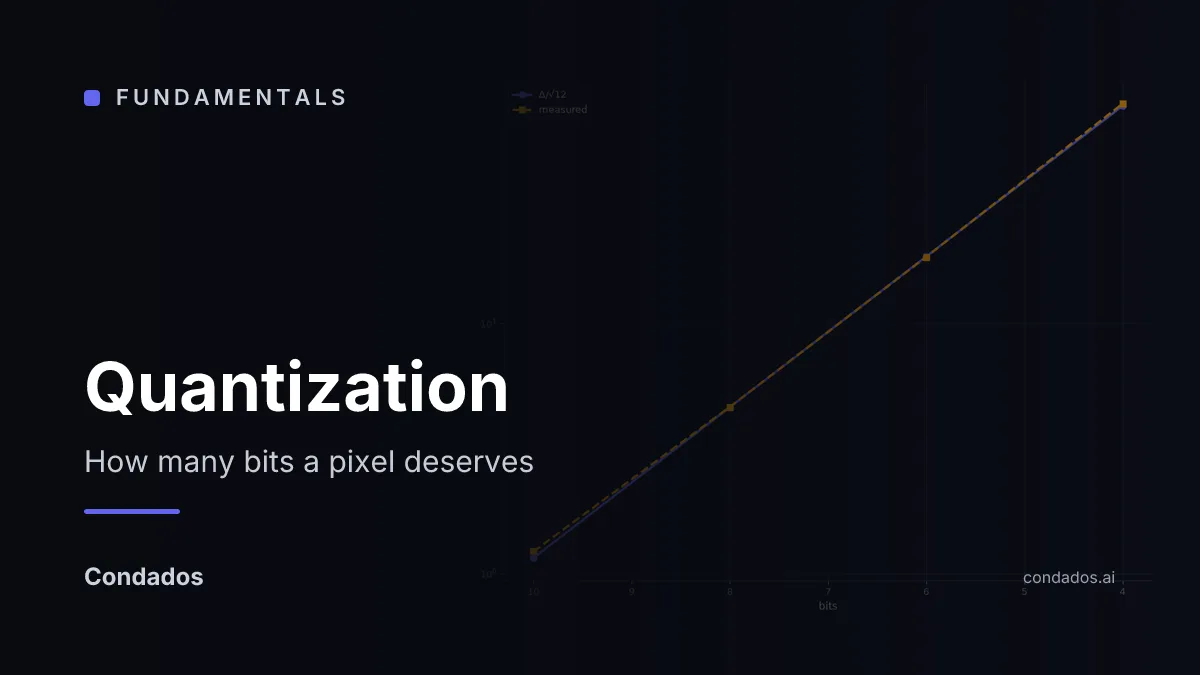
Lesson 3 of The Image as Data. Rounding to fewer levels costs Δ/√12 of error, and on this camera's mid-tones the formula predicts the measurement to within 2%. Set that error equal to the read noise unit 1.2 measured and the crossing lands at 9.3 to 9.5 bits — so a 12-bit file on this sensor carries about two and a half bits of nothing.
 Fundamentals
 Sensing Colour: The Bayer Mosaic, and What Interpolation Costs
Lesson 5 of Image Sensing. A silicon photosite is colourblind, so a mosaic of filters gives each one a single colour — a quarter red, a quarter blue, half green. Two thirds of every colour image is therefore interpolated, and measured against photosites that actually exist, that guess costs 4.7 DN on a flat patch and 129.9 DN at an edge: twenty-eight times worse where it shows.
 Fundamentals
 Sensor Noise and Dynamic Range: Measuring the Gain You Were Never Told
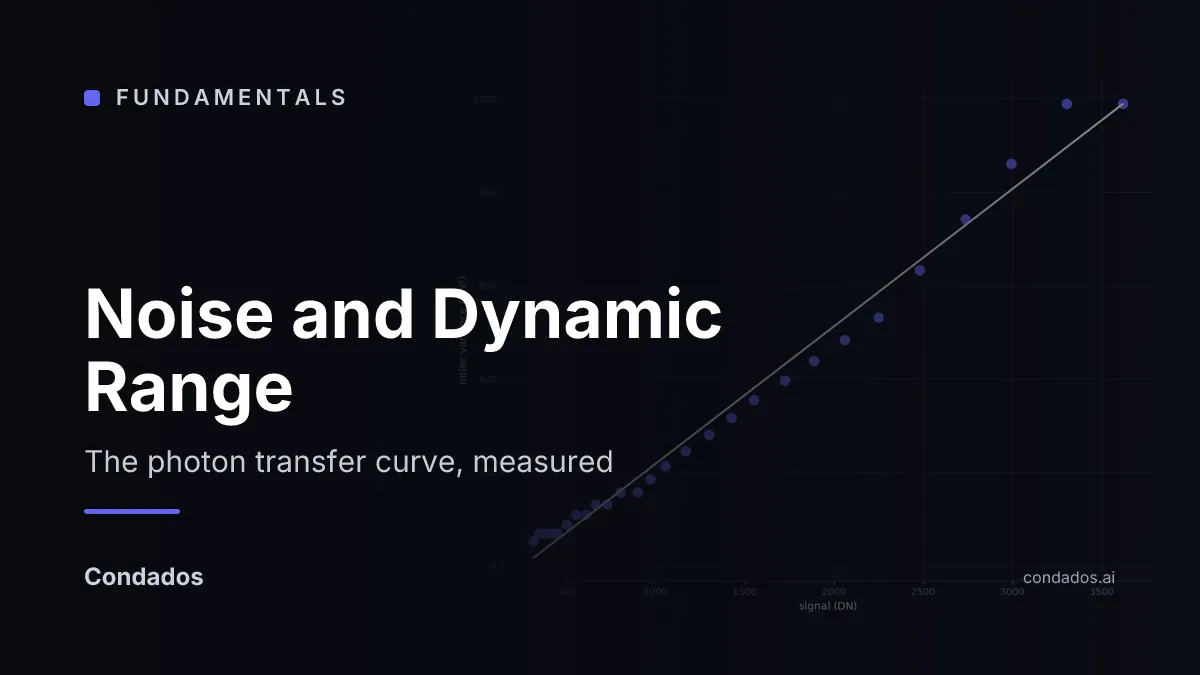
Read the same photosite three times and you get three numbers. Plotting the variance of a count against its mean gives a straight line whose slope is the sensor's gain: 0.294 DN per electron on this camera, R² = 0.986, a full well of 13,199 electrons and at least 11.21 stops of dynamic range — none of which appears anywhere in the file.
 Fundamentals
 The Camera Response Curve: Why Your JPEG Is Not Proportional to Light
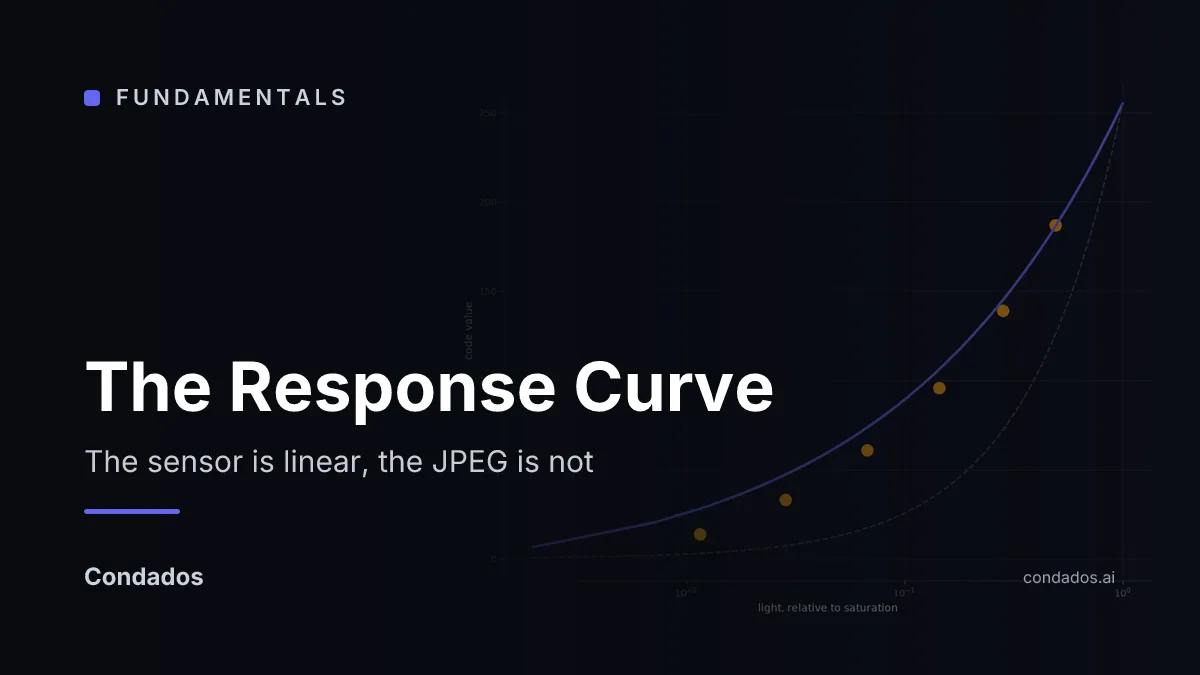
Raw counts are proportional to the light that arrived. The developed file is not: on the same six neutral patches, a linear ratio of 42 to 1 comes out as 187 against 14 code values. Measured here — a single exponent misses by 9.6 code values, because the curve is a gamma with a contrast S stacked on it.