
homography
6 posts · browse all tags
 Fundamentals
 Rotate, Scale, Shear: Images as 2×2 Matrices
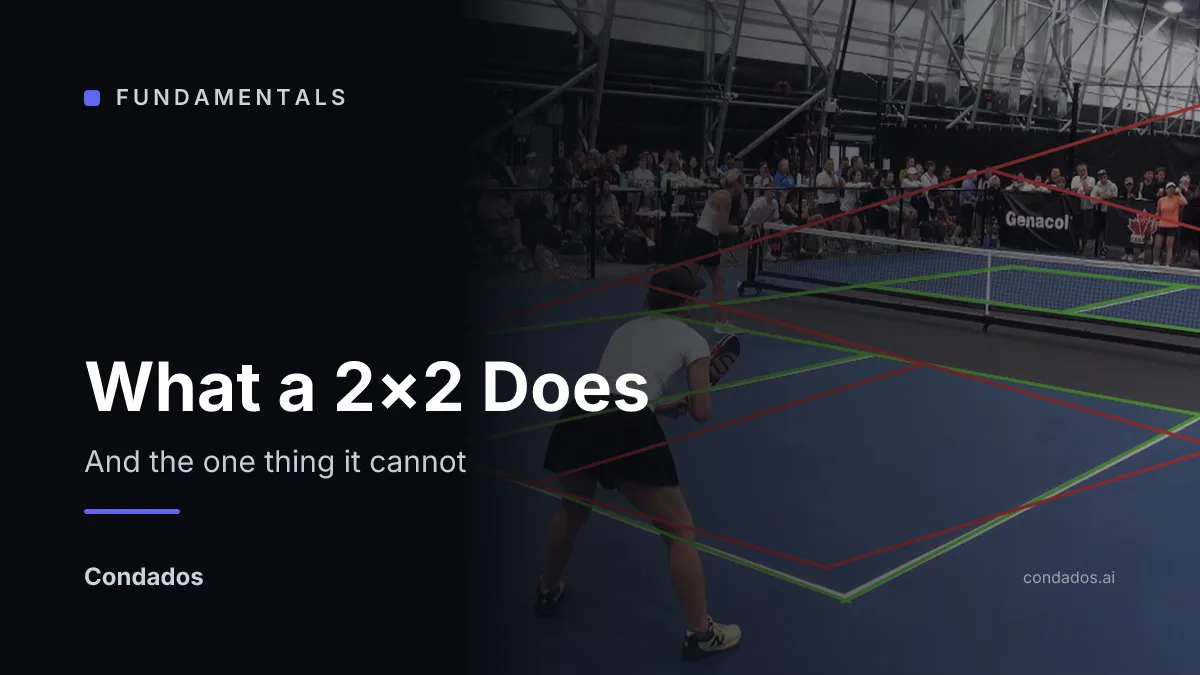
Lesson 1 of Image Alignment. A 2×2 matrix is where it sends the two axes; its determinant is how much it scales area and its SVD is rotate, stretch, rotate. The one thing it cannot do is make parallel lines meet. On a pickleball court, the sidelines are 20.35° apart in the photograph, so the best 2×2 misses every corner by 60 px.
 Fundamentals
 Affine vs Perspective Transform
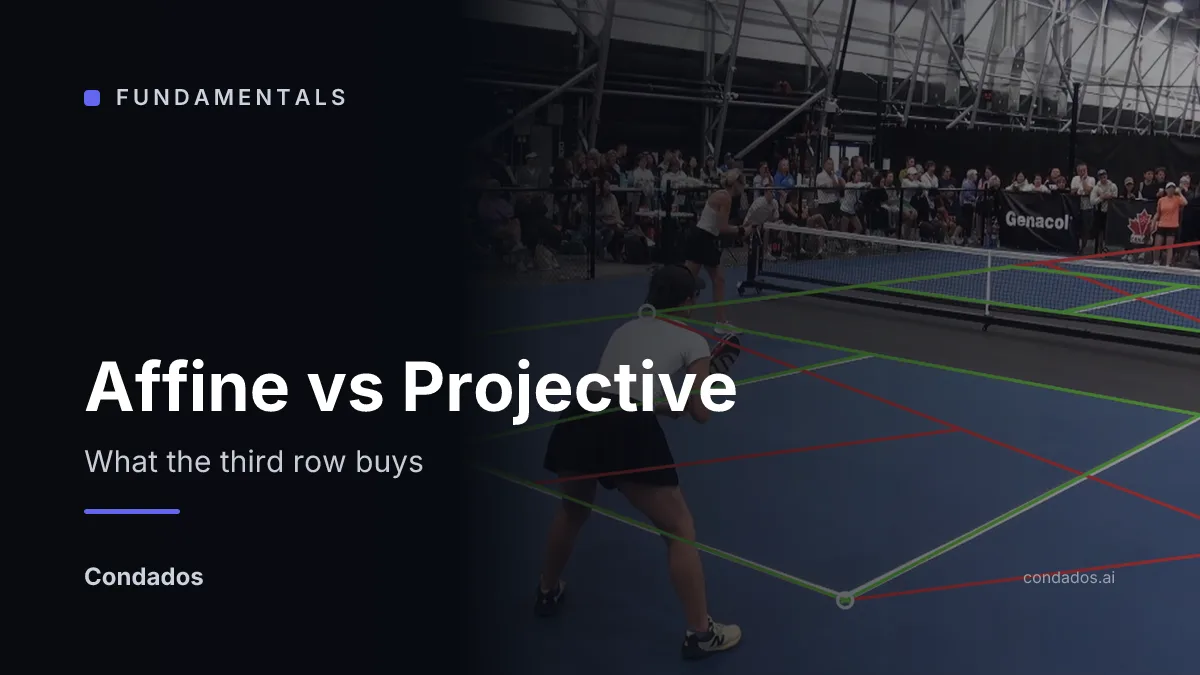
Lesson 2 of Image Alignment. Written on (x, y, 1), a 3×3 matrix can translate (affine, six numbers) and, once its last row is allowed to vary, make parallel lines meet (projective, eight numbers). On a pickleball court, an affine map fixed by three corners misses the fourth by 3.50 m; a homography through four lands the held-out centre-line corner 0.47 cm from the rulebook.
 Fundamentals
 How to Compute a Homography from Four Points
Lesson 3 of Image Alignment. Each point pair gives two linear equations in the nine entries of H, and the answer is the singular vector of the smallest singular value. Normalising the coordinates drops the condition number from 53,466 to 6.4, and on this court changes the answer by under 0.2 cm. What decides the error is where the pixels are: one pixel is 0.6 cm of court at the near baseline and 8.1 cm at the far one.
 Fundamentals
 Homogeneous Coordinates: Why Vision Adds a 1
Lesson 1 of Camera Geometry, and the prerequisite of Image Alignment. Add a third coordinate and a point becomes a ray, a line becomes a 3-vector, and both the line through two points and the point where two lines cross are one cross product. Measured on a pickleball court: a corner 18.5 px outside the frame, found anyway, and two sidelines that are parallel on the ground meeting 2,252 px to the right.
 Fundamentals
 Bird's-Eye View and Panoramas: Warping with a Homography
Lesson 5 of Image Alignment. Pushing each pixel forward through H leaves holes in 56% of the far court's bird's-eye view; pulling each output pixel back fills every one exactly once, and matches OpenCV's warpPerspective to one grey level. Interpolation decides what the pulled-back value is. Then a median of 31 warped frames removes the players, who cover 7% of the court in one frame.
 Fundamentals
 What Is a Homography?
The unit overview: what a 2×2 matrix can do to a picture, why a 3×3 is the smallest map that fits a plane seen in perspective, how four correspondences determine it, how to survive the wrong ones, and how to resample the image through it. Measured on one frame of a pickleball final: an affine map misses the court's far sideline by 3.97 m where a homography misses it by 6 cm.