
color-spaces
4 posts · browse all tags
 Fundamentals
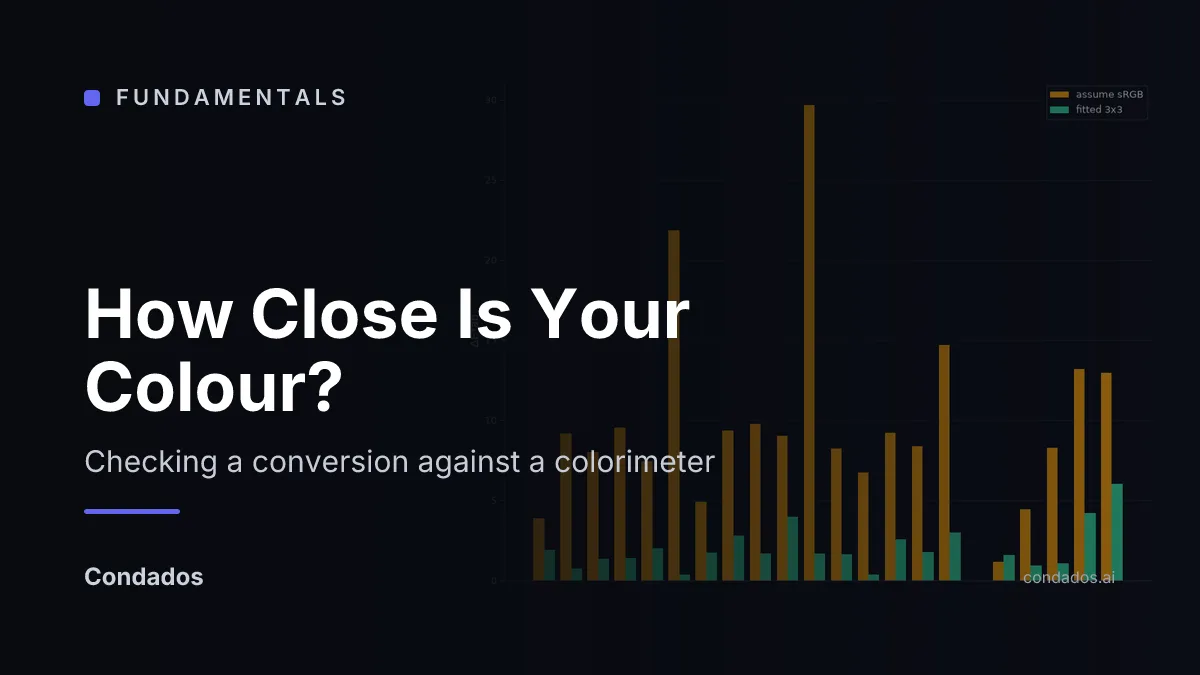
How Close Is Your Colour to the Real Thing?
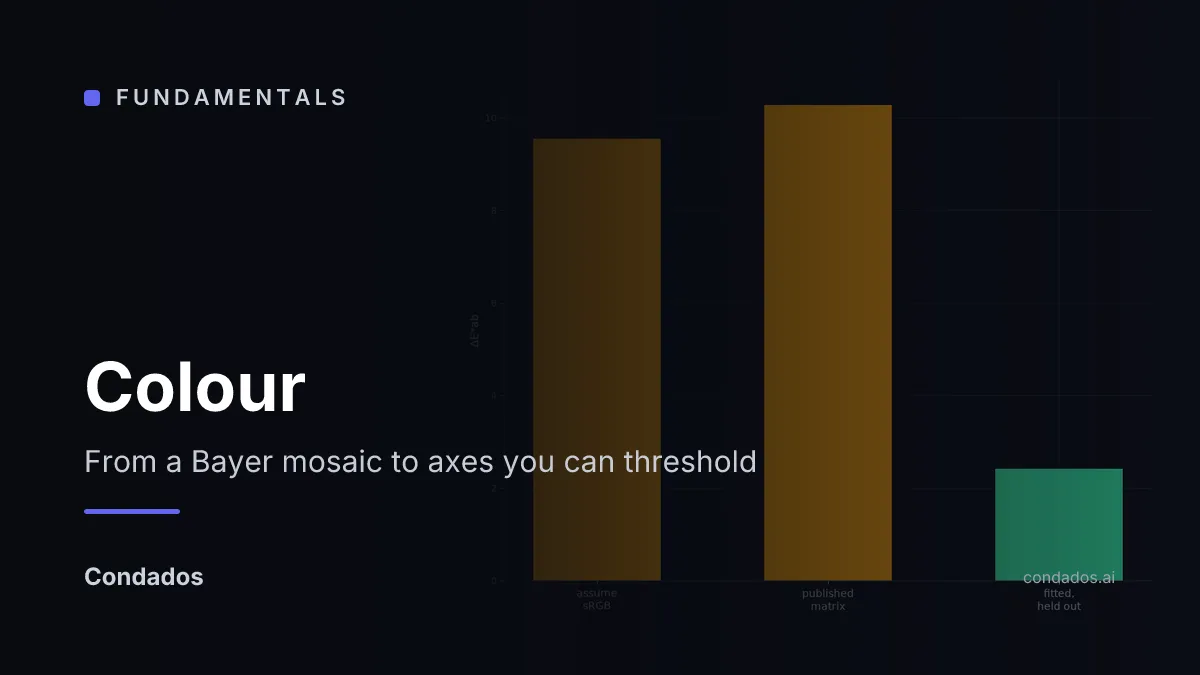
Lesson 5 of The Image as Data. Converting between colour spaces is exact arithmetic; deciding what the numbers mean physically is a fit. Checked against a colorimeter on 22 chart patches: treating the developed file as sRGB lands 9.54 ΔE*ab from the light in the room, the camera's own published matrix does no better, and a 3x3 fitted here and scored on patches it never saw reaches 2.41.
 Fundamentals
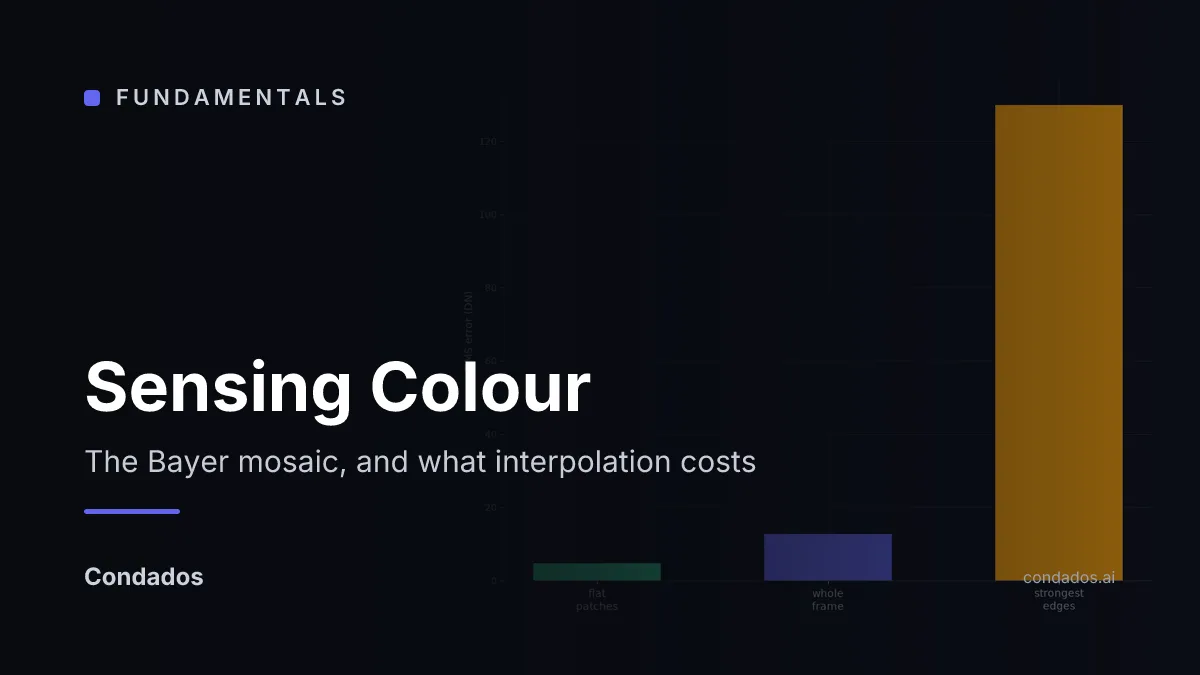
Sensing Colour: The Bayer Mosaic, and What Interpolation Costs
A silicon photosite is colourblind, so a mosaic of filters gives each one a single colour: a quarter red, a quarter blue, half green. Two thirds of every colour image is therefore interpolated, and measured against photosites that actually exist, that guess costs 4.7 DN on a flat patch and 129.9 DN at an edge, twenty-eight times worse where it shows.
 Fundamentals
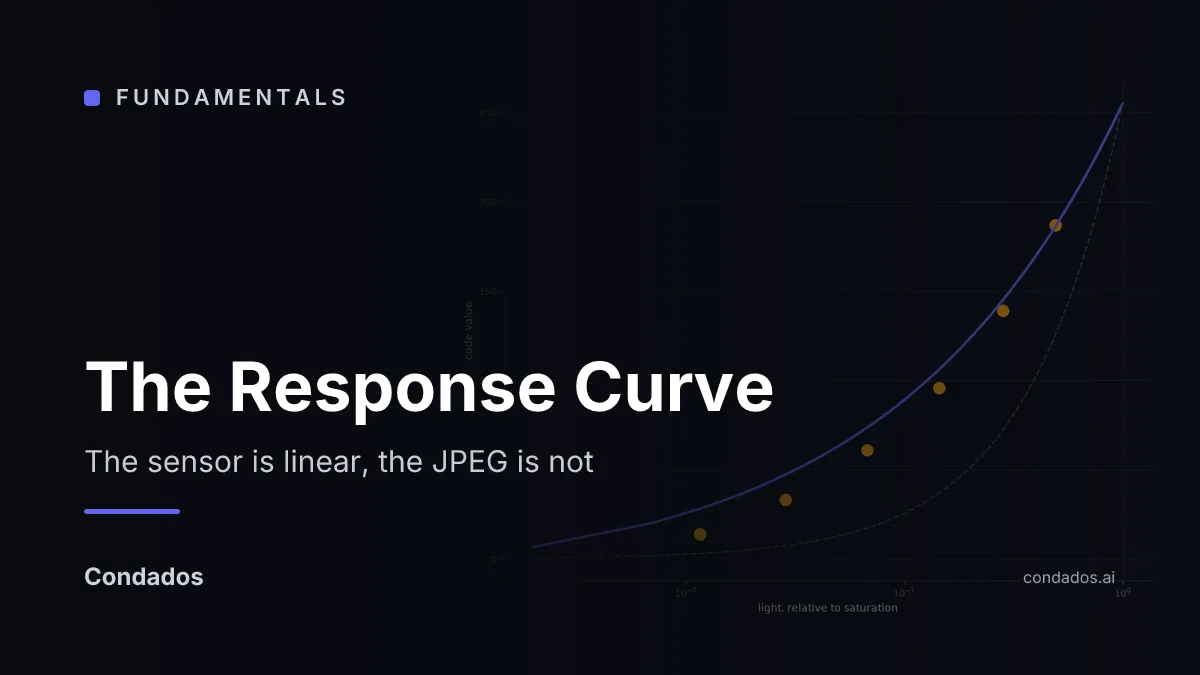
The Camera Response Curve: Why Your JPEG Is Not Proportional to Light
Raw counts are proportional to the light that arrived. The developed file is not: on six neutral patches, a 42:1 ratio of light comes out as 187 against 14 code values. Measured here, the file sits a mean 9.6 code values off the sRGB curve, and the BT.709 curve the developer applied by default accounts for most of that.
 Fundamentals
Colour Spaces: Choosing Axes You Can Threshold
Lesson 4 of The Image as Data. A colour space is a choice of axes for the same three numbers, and the choice is what makes a question easy or impossible. Worked on one measured chart patch: RGB (149.8, 58.3, 34.0) becomes luma 82.8, hue 12.6 degrees stored as 6, and Lab (36.9, 37, 34), plus the five-line red detector that is brittle in RGB and robust in HSV.