CNN vs Transformer, quantized: YOLO26-seg and RF-DETR-Seg race for instance masks on an Intel iGPU
Two opposite small segmentation models, a 2026-era CNN and a DETR transformer, both quantized to INT8 with NNCF and run on a laptop Intel iGPU. YOLO26-seg's forward pass is ~7.4× faster; RF-DETR-Seg keeps its masks more faithful under INT8 on the CPU, and its fully-quantized mask head breaks on the iGPU. The whole shootout, numbers first.
A 2026-era CNN and a DETR transformer, both quantized to INT8 and run on the laptop iGPU you already own. On an Intel Iris Xe, YOLO26-seg’s forward pass is ~2.1× faster at INT8 than at FP32 on the same iGPU (9.3 ms, ~107/s), and ~7.4× faster than RF-DETR-Seg. The transformer keeps its masks more faithfully under INT8 on the CPU (0.95 vs 0.87 IoU); on the iGPU its fully-quantized mask head breaks outright. And weight-only INT8? Zero iGPU speedup. Here’s the whole shootout.
Corrected 18 August 2026: the mask-retention numbers are CPU measurements, and full-INT8 RF-DETR draws no masks on the iGPU. Details in the correction log.
Why bother doing this on an iGPU?
Instance segmentation, a mask per object rather than just a box [6], is the expensive end of real-time vision. The reflex is to reach for an NVIDIA GPU. But most laptops, mini-PCs and industrial edge boxes ship with an Intel integrated GPU sitting idle, and OpenVINO turns it into a real inference accelerator for free: no cloud, no discrete card, no per-frame egress cost.
The open question for a practitioner is which model family. Two strong, very different small seg models landed in early 2026:
- YOLO26n-seg: Ultralytics, a CNN, NMS-free and DFL-free [2], 640×640.
- RF-DETR-Seg-Nano: Roboflow, a DETR transformer (DINOv2 backbone [5]), 384×384 [1].
CNN vs transformer, same iGPU, one shared INT8 pipeline. Which wins on latency, and do the masks survive quantization? This is a segmentation sequel to earlier detection benchmarks: same hardware, now with masks.
The approach in one flow
coco128-seg → export each model to OpenVINO FP32 IR → one NNCF pipeline
            → {weight-only INT8, full-PTQ INT8} per model
→ benchmark forward latency + mask-IoU retention on {CPU, iGPU}- Models:
yolo26n-seg.pt(Ultralytics) andRFDETRSegNano(Roboflow), nano tier. - Data:
coco128-seg(128 COCO images with masks) [3], used for calibration and eval. - Runtime: OpenVINO 2026.2, NNCF INT8 [7].
- Hardware: Intel Core i7-12700H, with the Iris Xe iGPU (
GPU.0) and the CPU.
Everything is a uv run seg-<verb> command; the whole thing reproduces from
uv sync.
Build walkthrough
1. Export: two export paths, one IR layout
The two families could not export more differently. YOLO26 exports to OpenVINO in
one Ultralytics call; RF-DETR goes through ONNX and ov.convert_model
(cli/export.py):
# YOLO26: Ultralytics emits the IR folder directly
YOLO("yolo26n-seg.pt").export(format="openvino", imgsz=640, half=False, dynamic=False)

# RF-DETR: export ONNX (opset 18, static shape) → convert to OpenVINO IR
model = RFDETRSegNano()
model.export(output_dir=tmp, opset_version=18, shape=(res, res))
ov_model = ov.convert_model(onnx_path)
Two gotchas surfaced immediately, both worth knowing:
YOLO26 is end-to-end. Its seg export does not produce the legacy
(1, 116, 8400) raw grid. Being NMS-free, it emits (1, 300, 6 + 32),
up to 300 already-deduplicated instances, each
[x1, y1, x2, y2, conf, cls, 32 mask coeffs], plus a (1, 32, 160, 160)
prototype bank. No NMS, no transpose: just threshold and assemble masks
(core/yolo26.py):
det = det[0]                  # (300, 38): [x1,y1,x2,y2,conf,cls,coeffs]
boxes, conf, cls, coeffs = det[:, :4], det[:, 4], det[:, 5], det[:, 6:38]
masks = sigmoid(coeffs @ proto.reshape(nm, mh * mw)).reshape(-1, mh, mw)
RF-DETR’s mask head won’t trace through the legacy ONNX exporter. It
upsamples with antialiased bicubic (aten::_upsample_bicubic2d_aa), which the
TorchScript exporter can’t emit. We disable antialiasing just for the export
trace, because masks are thresholded afterward, so the effect is nil:
def _no_antialias(*args, **kwargs):
    if kwargs.get("antialias"):
        kwargs["antialias"] = False
    return orig_interpolate(*args, **kwargs)
The RF-DETR IR then emits three tensors: boxes (1, 100, 4), logits
(1, 100, 91) (COCO’s sparse 1-90 indexing, not contiguous-80 like YOLO), and
mask logits at a compressed (1, 100, 96, 96). Those low-res logits must be
bilinearly upsampled before thresholding, the documented RF-DETR gotcha,
handled in core/rfdetr.py:
up = cv2.resize(mask_logits[q], (orig_w, orig_h), interpolation=cv2.INTER_LINEAR)
mask = sigmoid(up) >= 0.5
2. Quantize: one NNCF pipeline for both
The fair-comparison move: instead of letting each framework quantize its own way,
both FP32 IRs go through the same NNCF code
(cli/quantize.py), with weight-only
(compress_weights) and full PTQ (nncf.quantize calibrated on coco128-seg).
The only per-model difference is the preset. RF-DETR, being a transformer, gets
ModelType.TRANSFORMER so SmoothQuant [4] protects its attention and LayerNorm:
kwargs = {"model_type": nncf.ModelType.TRANSFORMER} if name == "rfdetr" else {}
quantized = nncf.quantize(core.read_model(src), nncf.Dataset(tensors), **kwargs)
Calibration reuses each model’s inference preprocessing (YOLO letterboxes; RF-DETR squashes + ImageNet-normalizes), so the quantized path sees the exact input distribution it will see at runtime.
3. The device-family trap
get_available_devices() returns GPU.0 / GPU.1, never a bare GPU. A naive
"GPU" in available check fails, silently falling back to CPU, so your “iGPU”
benchmark is really a CPU benchmark. The resolver in
core/common.py matches families:
if any(d == requested or d.startswith(requested + ".") for d in available):
    return requested
On this machine GPU.0 is the Intel Iris Xe (our target) and GPU.1 is a
discrete NVIDIA card OpenVINO also enumerates, GPU correctly resolves to the
iGPU.
Results
Speed is the raw OpenVINO forward latency, the part quantization actually accelerates, measured identically for both families (mask post-processing is CPU-side Python either way). Each cell is the median of 3 runs of 50 timed passes after warmup, batch 1.
Speed: FP32 vs INT8, CPU vs iGPU
| model | precision | device | mean ms | p50 ms | p90 ms | img/s |
|---|---|---|---|---|---|---|
| yolo26 | fp32 | CPU | 56.89 | 35.47 | 101.95 | 17.6 |
| yolo26 | fp32 | GPU | 19.74 | 19.20 | 21.52 | 50.7 |
| yolo26 | int8_woq | CPU | 57.42 | 34.77 | 103.93 | 17.4 |
| yolo26 | int8_woq | GPU | 19.96 | 19.53 | 21.95 | 50.1 |
| yolo26 | int8_full | CPU | 32.98 | 17.22 | 64.94 | 30.3 |
| yolo26 | int8_full | GPU | 9.32 | 9.36 | 9.52 | 107.3 |
| rfdetr | fp32 | CPU | 429.18 | 302.36 | 730.56 | 2.3 |
| rfdetr | fp32 | GPU | 86.61 | 85.63 | 91.65 | 11.5 |
| rfdetr | int8_woq | CPU | 322.23 | 193.74 | 596.09 | 3.1 |
| rfdetr | int8_woq | GPU | 90.75 | 87.33 | 102.95 | 11.0 |
| rfdetr | int8_full | CPU | 233.51 | 142.05 | 430.10 | 4.3 |
| rfdetr | int8_full | GPU | 68.81 | 66.46 | 77.43 | 14.5 |
Mask quality retention (INT8 vs FP32 reference)
Foreground-mask IoU of each INT8 model against its own FP32 output, over 30 coco128-seg images, plus the mean instance count. Measured on the CPU, in ACCURACY execution mode (see Measurement notes). On the iGPU this table does not transfer to RF-DETR’s full-INT8 row: there its masks come out empty — see the correction log.
| model | precision | mask IoU vs fp32 | mean #inst | fp32 #inst |
|---|---|---|---|---|
| yolo26 | int8_woq | 0.959 | 4.5 | 4.4 |
| yolo26 | int8_full | 0.870 | 3.5 | 4.4 |
| rfdetr | int8_woq | 0.958 | 4.5 | 4.5 |
| rfdetr | int8_full | 0.950 | 4.4 | 4.5 |
The headline numbers
I lead with same-device ratios, because those are the stable signal. The CPU baseline on this P/E-core part is noisy (see Measurement notes).
- Full INT8 is ~2.1× faster than FP32 on the same iGPU (9.32 vs 19.74 ms), the clean, apples-to-apples quantization win.
- YOLO26 is ~7.4× faster than RF-DETR at INT8 on the iGPU (9.32 vs 68.81 ms), despite running at 640 while RF-DETR runs at 384.
- In absolute terms that’s ~107 forward passes/s on the iGPU for YOLO26. Versus the CPU it’s very roughly 3.5–6×, but treat the CPU multiplier as a ballpark, because its latency distribution is heavily tail-skewed on this machine.
Measurement notes
A few things to read the tables honestly, and to reproduce them fairly:
- Forward-only. Latency and “img/s” are the raw OpenVINO forward pass (batch 1), not end-to-end FPS. Mask assembly (prototype matmul / query upsampling) and NMS-free decode run in CPU Python on top, so real per-frame FPS is lower. Forward-only is deliberate: it isolates what quantization actually changes and measures both families identically.
- Run-to-run variance. Each cell is the median of 3 runs, but the iGPU forward latency still moves ±10–20% across runs (thermal + whatever else the laptop is doing). FP32-iGPU in particular drifted between 19.7 and 21.6 ms across my runs. The same-device ratios are the stable signal, so lean on them, not the third decimal.
- Quality eval runs on the CPU, in ACCURACY mode. Speed uses the deployment-realistic PERFORMANCE hint (reduced precision, where INT8 gets its iGPU win). Quality was measured separately, on the CPU, for two reasons: the PERFORMANCE hint can intermittently corrupt a weight-only-INT8 model’s outputs when the same IR was compiled on the GPU earlier in the same process (I caught it producing 300 garbage detections on one run), and — found after publication — the iGPU has a harder problem entirely for RF-DETR’s full-INT8 masks (see the correction log). So the retention table isolates the pure quantization effect on CPU; it is not a statement about mask quality on the iGPU.
- mean vs p50. We report
mean. On the iGPU the distribution is tight so it barely matters; on the CPU it is tail-heavy (12700H P/E cores + thermal throttling), somean≫p50. If you compare devices,p50is the fairer central stat. - The RF-DETR decode is a simplified reimplementation. I do per-query
argmax + threshold; RF-DETR’s official post-processor does a global top-K over
the flattened (query × class) score matrix. I validated mine against the native
.predict(), with instance counts landing within ~0.4/image, so it’s faithful, but it is not bit-identical. The within-model INT8-vs-FP32 retention is unaffected either way (same decode on both precisions). - The mask metric is retention, not accuracy. “Mask IoU vs fp32” is the instance-agnostic foreground-union IoU against each model’s own FP32 output, it answers “does INT8 still draw the same masks?”, not “are the masks correct?”. Absolute quality would need a COCO mask-mAP run.
- Confidence thresholds differ (YOLO 0.25, RF-DETR 0.5, each family’s native default), so cross-model instance counts (4.4 vs 4.5) aren’t directly comparable; the per-model retention is.
The honest findings
1. Weight-only INT8 buys you nothing on the iGPU. YOLO26 weight-only is 19.96 ms vs 19.74 ms FP32, which is indistinguishable. RF-DETR weight-only is actually slower on the iGPU (90.8 vs 86.6 ms): the on-the-fly weight decompression costs more than it saves when activations stay FP. Only full PTQ (activations quantized) unlocks the iGPU’s INT8 math. Weight-only still has a place, since it shrinks the model and helps a little on CPU, but it is not your iGPU speed lever.
2. INT8 helps the CNN far more than the transformer on the iGPU. YOLO26 gets a clean ~2.1× from full INT8 on the iGPU. RF-DETR gets only ~1.26× (86.6 → 68.8 ms). Most of RF-DETR’s win comes simply from being on the iGPU at all (CPU 429 ms → iGPU 87 ms); its attention matmuls and the einsum mask head don’t accelerate much under INT8. If you picked RF-DETR expecting INT8 to close the gap to YOLO, it doesn’t.
3. The surprise: the transformer keeps its masks better, on the CPU. I expected
DETR’s quant-sensitive attention to degrade masks more. The opposite happened:
RF-DETR-Seg held 0.95 foreground-mask IoU under full INT8 while YOLO26 fell to
0.87, dropping from 4.4 to 3.5 instances per image (it loses marginal-confidence
objects). NNCF’s TRANSFORMER preset (SmoothQuant) earned its keep. The caveat,
found after publication: this fidelity win is a CPU measurement. On the iGPU the
same full-INT8 model decodes every mask to empty (see the
correction log), so there the choice becomes YOLO26 INT8 for
speed, RF-DETR FP32 when its masks are worth 9 FPS.
4. Resolution caveat, stated plainly. YOLO26 runs at 640 and RF-DETR at 384, their native sizes. Even with that handicap the CNN is ~7.4× cheaper per frame, so the speed verdict is robust; but the IoU and instance-count numbers are each-model-vs-its-own-FP32, not cross-model accuracy, which would need a COCO mAP run.
Reproduce it
uv sync
uv run seg-download                              # coco128-seg
uv run seg-export   --model all                  # FP32 IR for both
uv run seg-quantize weight-only --model all
uv run seg-quantize full        --model all      # the iGPU speed lever
uv run seg-benchmark --devices CPU,GPU --repeats 3   # tables + latency.png
uv run seg-compare  --precision int8_full --device GPU   # the correction-log image
uv run python demo_video.py <clip>                       # the hero video
Stack: Python 3.11, ultralytics 8.4.56, rfdetr 1.7.1, openvino 2026.2.0,
nncf 3.1.0, torch 2.12.0 — these are the versions in the companion repo’s
uv.lock, so uv sync gives you exactly them. Hardware: Intel Core i7-12700H,
Iris Xe iGPU, 31 GB RAM, Ubuntu 22.04. --repeats 3 matches the published
protocol (median of 3 runs; the flag defaults to 1), and no NVIDIA GPU is needed
at any step. Every number above comes from output/benchmark.md / speed.csv
produced by seg-benchmark. Weights carry their own licences: yolo26n-seg.pt
is AGPL-3.0 (Ultralytics), RF-DETR-Seg-Nano is Apache-2.0 (Roboflow); the
repo downloads both and redistributes neither.
Takeaways
- On an Intel iGPU, full-PTQ INT8 is the speed lever; weight-only is not. Always quantize activations if latency is the goal.
- YOLO26-seg is the speed king at the nano tier, at ~107 forward passes/s on a laptop iGPU (forward-only; see Measurement notes), no NVIDIA in sight.
- RF-DETR-Seg trades speed for mask fidelity under INT8 on the CPU (0.95 vs 0.87 IoU). On the iGPU, run it FP32: full INT8 empties its masks there (see the correction log) and only bought 1.26× anyway.
- Match the export to the model. YOLO26 is end-to-end (no NMS to write); RF-DETR needs the antialias-export workaround and explicit mask upsampling.
- Next: push the same two models onto the Intel NPU, and add a COCO mask-mAP pass to turn “IoU vs FP32” into absolute accuracy.
For how mask-IoU and mask-AP are defined, see the segmentation metrics primer.
Correction log
18 August 2026 — RF-DETR’s full-INT8 masks are empty on the iGPU, and the retention table is a CPU measurement.
An audit re-run of the companion repo caught two things this post originally did not say:
- The mask-retention table is measured on the CPU (ACCURACY execution mode). The original text framed that as an execution-mode detail and never named the device.
- On the iGPU, the full-PTQ INT8 RF-DETR-Seg model produces no masks at all. Its mask logits come out far more negative on the GPU plugin than on CPU for the same input (mean −114 vs −23), and every instance decodes to an empty mask: zero foreground pixels on every image I tested. Boxes and scores are unaffected, weight-only INT8 is unaffected, YOLO26 is unaffected, and the same IR on the CPU is unaffected. It reproduces with the originally exported IR and with a freshly quantized one, in both PERFORMANCE and ACCURACY modes, on OpenVINO 2026.2. I have not localized which fused op the GPU plugin miscompiles, and I tested one OpenVINO release; this belongs in an upstream report.
The evidence was in the post from day one. The original hero image, kept below, ran both models at INT8 on the iGPU — and the RF-DETR half shows boxes with no mask fills. I published it without noticing.
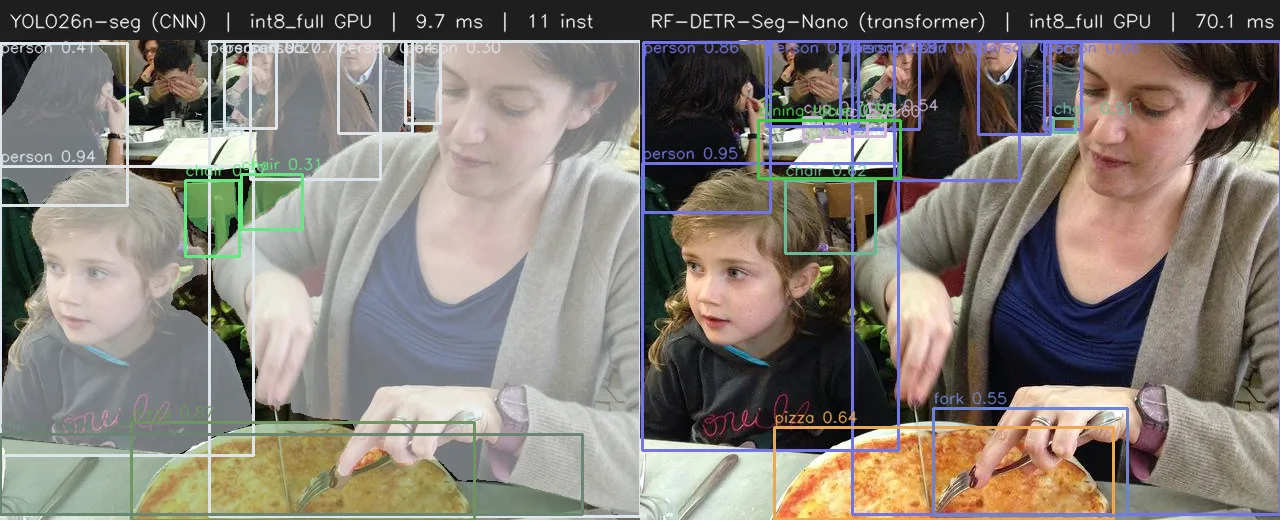 The original hero, kept as evidence: left, YOLO26n-seg INT8 masks a pizza
lunch; right, RF-DETR-Seg-Nano INT8 on the same iGPU draws only boxes.
The original hero, kept as evidence: left, YOLO26n-seg INT8 masks a pizza
lunch; right, RF-DETR-Seg-Nano INT8 on the same iGPU draws only boxes.
What changes: “the transformer keeps its masks better under INT8” is a CPU result, and on the iGPU RF-DETR’s usable mask configurations today are FP32 and weight-only INT8 (which is slower than FP32 there). The hero video now runs RF-DETR at FP32 for that reason. What does not change: every latency number (mask content has no effect on timing), every YOLO26 result, and the weight-only findings.
- Go deeper: Szeliski, Computer Vision (2nd ed.) §6.4 (semantic segmentation); for quantization, the OpenVINO NNCF post-training quantization guide (2026 docs, matching the 2026.2 runtime used here).
- The technique: SmoothQuant (Xiao et al., 2023) + NNCF docs, for transformer-aware post-training quantization.
- Related on CondadosAI: the detection prequel, RF-DETR vs YOLO-NAS at the edge; the metric definitions in segmentation metrics.
References
[1] Robinson, I., Robicheaux, P., Popov, M., Ramanan, D., & Peri, N. (2025). RF-DETR: Neural Architecture Search for Real-Time Detection Transformers. ICLR 2026. arXiv:2511.09554. GitHub.
[2] Jocher, G., et al. (2026). Ultralytics YOLO26: Unified Real-Time End-to-End Vision Models. arXiv:2606.03748. Model docs · GitHub. (YOLO26-seg.)
[3] Lin, T.-Y., et al. (2014). Microsoft COCO: Common Objects in Context. ECCV. arXiv:1405.0312. (coco128-seg subset.)
[4] Xiao, G., Lin, J., Seznec, M., Wu, H., Demouth, J., & Han, S. (2023). SmoothQuant: Accurate and Efficient Post-Training Quantization for Large Language Models. ICML. arXiv:2211.10438. (The technique behind NNCF’s TRANSFORMER preset.)
[5] Oquab, M., et al. (2023). DINOv2: Learning Robust Visual Features without Supervision. TMLR. arXiv:2304.07193. (RF-DETR backbone.)
[6] Szeliski, R. (2022). Computer Vision: Algorithms and Applications (2nd ed.), §6.4 (semantic segmentation). Springer. Free PDF.
[7] Intel. OpenVINO Toolkit Documentation (2026.2) and NNCF (Neural Network Compression Framework) 3.1.0. Docs · NNCF.